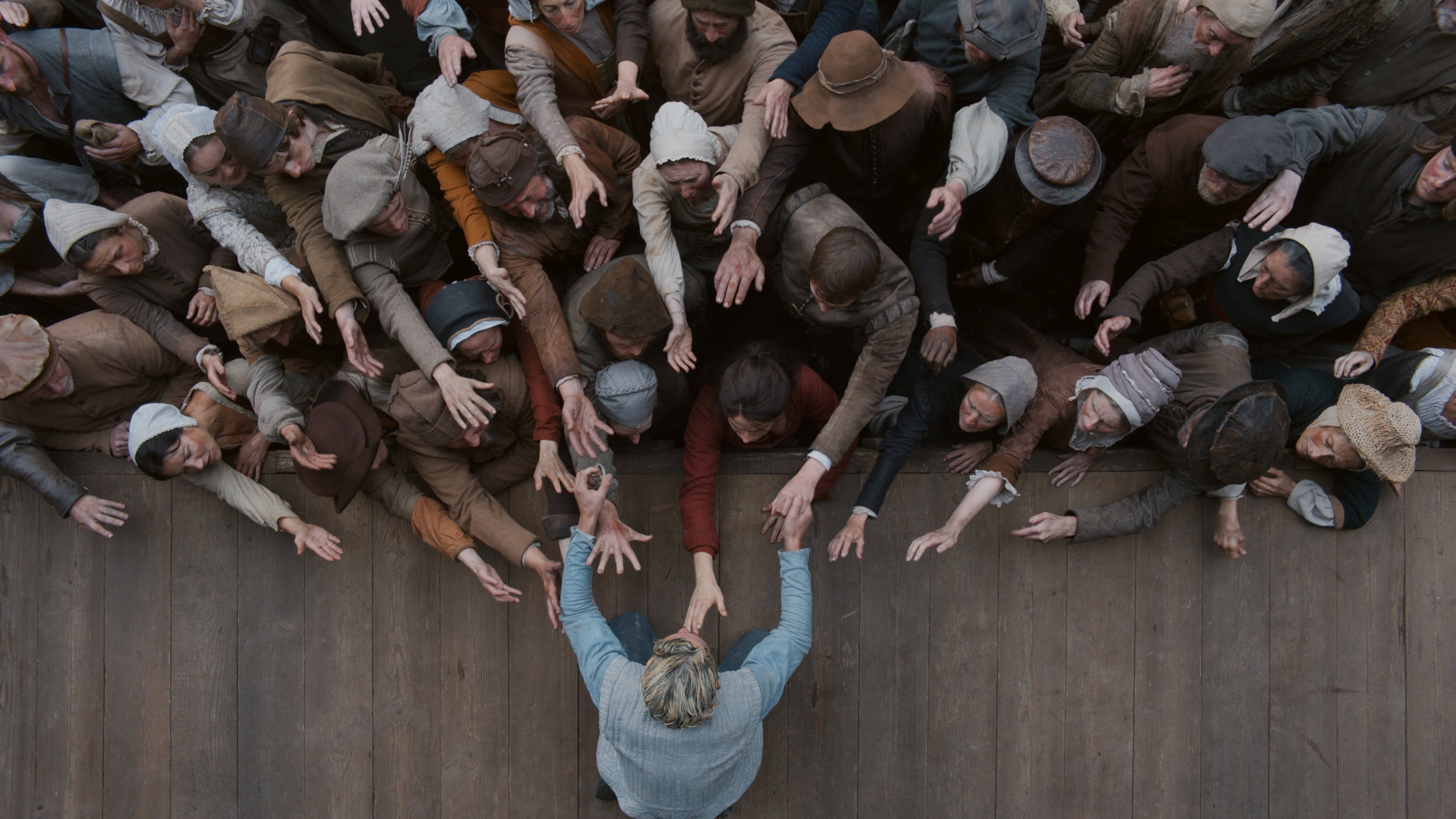

There’s a certain mythology surrounding works that have outlived their own creators, especially if they’ve outlived them for hundreds of years. For the works of Shakespeare, even that might be damning them with faint praise. His works have endured for centuries for numerous reasons, but beyond that, there is a fascination with trying to imagine the inspirations behind their creations. That’s what itself inspired the novel “Hamnet” by Maggie O'Farrell which then itself has been adapted by co-writer/director Chloé Zhao (“Nomadland,” “Eternals”) and O’Farrell herself into this work.
The film follows William Shakespeare, played by Paul Mescal (“Aftersun,” “All of Us Strangers), and his wife Agnes, played by Jessie Buckley (“The Lost Daughter,” “i’m thinking of ending things”), from their initial meeting and courtship through their marriage and the births of their three children: Susanna, played by Bodhi Rae Breathnach, Judith, played by Olivia Lynes, and the titular Hamnet, played by Jacobi Jupe (“Peter Pan & Wendy,” “Before (2024)”). With William in London working in the theatre, the plague reaches the family, eventually taking the life of a young Hamnet. The strain on Agnes and William’s relationship after his death then inspires William to write arguably his most famous work, “The Tragedy of Hamlet, Prince of Denmark.”
While O’Farrell’s original novel is a fictionalized interpretation of Shakespeare’s life (he did have a son named Hamnet who passed away before he made “Hamlet”), Zhao and O’Farrell ground it in a deep emotional truth that they spread throughout the film. Watching Agnes and William’s relationship ebb and flow throughout the film is a deeply affecting experience. These are two performances anchored by their actors’ skills and the depth of the material at work. Buckley gives a career best performance, wallowing in the sort of grief that only a mother can express, while also showcasing great and varied joy throughout her life. Mescal is slightly more one note, if only because he hides behind William’s tortured artist persona for some of the film. Regardless of that though, this is clearly Buckley’s film to lead and she does so exceptionally.
The surrounding supporting cast has plenty of great, if brief, highlights. Breathnach and Lynes have a wonderful sibling dynamic, with Lynes getting some particularly great moments with Jupe. But it is Jupe himself who delivers a truly fantastic performance, one of the best performances from a young actor this entire year. The way he’s able to perfectly encapsulate this kind of sibling bond and tragedy within his arc is nothing short of heartbreaking.
Zhao’s strengths lie in the quiet, reflective moments that rhyme with their futures, and “Hamnet” showcases plenty of moments like that. Whether an imposing pit of inky blackness or the slowly encroaching surrounding river, Zhao and O’Farrell’s story runs rampant with visual motifs and symbolism that’s wonderful to immerse deeply into. Large stretches of the film have little to no dialogue as well, allowing Zhao and cinematographer Łukasz Żal (“The Zone of Interest,” “i’m thinking of ending things”) to fully encapsulate the film’s mood with gorgeous forests and English landscapes. It also proves to be an excellent statement on the powerful catharsis of art in general, and the way it can touch us despite the depth of our grief. The moments when it depicts this are some of the most wonderful in the entire work, and it’ll be one of many times you’ll likely be reaching for the tissues.
For a film as calm and deliberately paced as this, the first act does present a minor hiccup on its journey to that patter. The first act feels remarkably slower than the rest of the already slow film, leading to it simply being the least interesting part of the film. It still maintains the same gorgeous visuals and performances, but the film simply takes time to ramp up to its most engaging aspects. Max Richter’s (“The Leftovers,” “Ad Astra”) score is also slightly underwhelming, at times positively perfect in its beauty and musical motifs, and other times confoundingly heavy handed. A moment of anticipation as Agnes approaches the Globe theatre for the first time, for example, is scored with an almost apocalyptically thundering menace. It’s still good music, but it's one of a few moments that feel as though the score is attempting to tell the viewer what to feel rather than letting it accompany the film.
Those two detractions will likely matter far less to some viewers, as they are slight dings against a truly fantastic and cathartically overwhelming emotional experience. Buckley and Mescal take charge of a great cast, with Jupe proving to be a deeply emotional surprise. It’s a tale of love for a couple responsible for some of the English language’s greatest love stories, and it's told with a deft and impressive hand that makes this a can’t miss emotional experience to end the year on. 5/5
No comments:
Post a Comment